


EcoFlow DELTA 3 Plus — 4-day test in the Beskidy mountains (VW California)
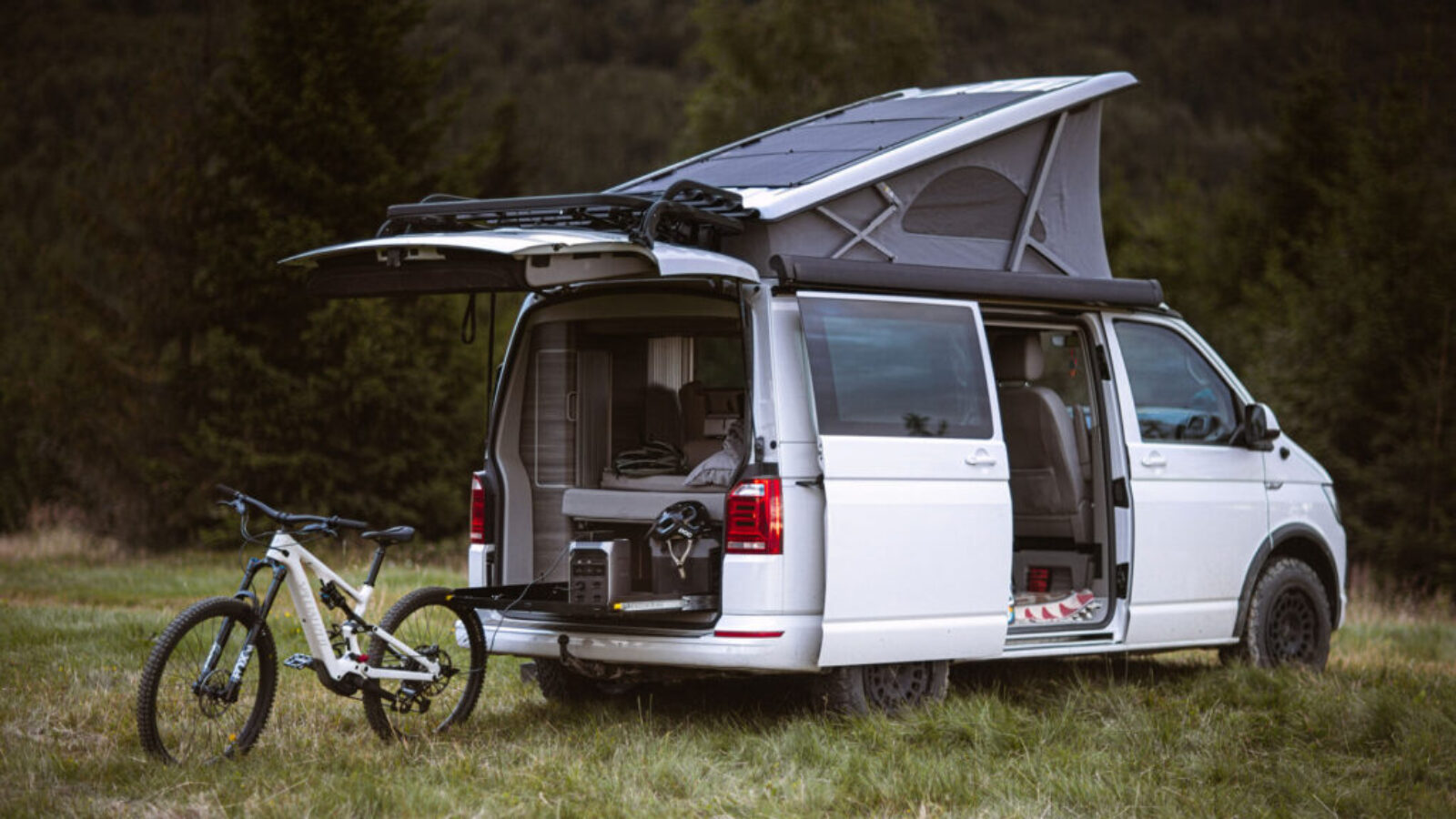
EcoFlow DELTA 3 Plus test — what 4 days in a camper without cables and campsites really look like.
A morning in the camper, when everything just works
It’s 6:30 in the morning, mist hangs over Lipowski Wierch. I’m sitting in the VW California with a mug of coffee — freshly ground, the espresso machine just finished its job.
Outside, silence. Just birds. No generator droning, no scrambling for a socket.
This is the moment when you realise that EcoFlow DELTA 3 Plus isn’t a gadget — it’s freedom.
TL;DR for the busy
- ✅ Charged 2 e-bikes, cooked and worked for 4 days
- ✅ Quiet — about 30 dB (essentially inaudible)
- ✅ Charging: from a wall socket in 56 minutes, from the alternator in 1h 20m, from solar in about 70 minutes
- ✅ 4,000 cycles = 10 years of use
- ❌ Price 3,500 PLN — a high entry barrier
👉 Check the current price in our store.
EcoFlow DELTA 3 Plus test in the Beskidy mountains — day by day
Day 1 — Roof panels and on-the-road charging
Before setting off, the station was at 45% — overnight e-bike charging took a chunk out of it.
- 10:00 — the 300W roof panel is working, but output is only 196W (MPPT controller limit).
- 13:00 — station shows 80%, vehicle batteries already full (100%).
- 15:00 — DELTA reaches 100% charge, vehicle batteries also at 100%.
✅ Real numbers that confirm the system is genuinely useful.
Day 2 — Mist and the alternator
Foggy morning, visibility down to a few dozen metres. Panels are essentially not working — 20–30W is too little to actually charge the station. Good moment to test the alternator charger.
- 9:00 — we drive down to Żabnica, top up water and pick up groceries for lunch.
- 10:23 — back to our favourite spot. Shopping done, water topped up, station already at 100%. Charging time — 1h 23m of city driving.
In the evening, X-Boost test: shower (660W) + toaster (600W) + e-bike charging (160W). Total 1,420W of load — and the station handles it without skipping a beat.
Day 3 — Daily routine without rush
Calm morning — no rush this time, time for work and rest.
- Morning — laptop plugged into the DELTA, 150W draw while editing photos and prepping content.
- Evening — relaxing with a film, the projector pulled around 100W for 2–3 hours.
The whole day stayed within reasonable consumption, and thanks to the roof panels the energy level kept comfortably in the green.
Day 4 — Comfort and independence
Morning standard: espresso and toast. Energy from the panels covers the running consumption.
- Daytime work — laptop (150W), charging cameras and drone.
- Afternoon — shower boiler (660W) ran for almost an hour.
- Evening — LED lights, music, charging phones.
Energy recovered from the panels kept full autonomy — the station never dropped below 70% all day.
Average panel recovery: approx. 920 Wh/day
➡️ The whole time we were energy-positive.
Verdict — who wins?
- Best mix of speed, silence and stability → EcoFlow DELTA 3 Plus
- Quietest in class → Jackery Explorer 1000 v2
- Largest capacity → Bluetti AC180, but louder fan
- Slowest charging → Goal Zero Yeti 1000X
👉 If fast charging and camper comfort matter — EcoFlow wins in practice.
What does it actually cost? (ROI)
vs a fuel generator
- 2kW generator: 2,500 PLN + 8 PLN/h fuel ≈ 4,400 PLN/year
- DELTA 3 Plus: 3,500 PLN + 0 PLN running cost
➡️ Pays for itself in roughly a year.
vs campsites
- Campsite: 100 PLN/night
- Wild camping with DELTA: 0 PLN/night
- 30 nights per year = saving of 3,000 PLN
Summary — my take after 4 days
For me, EcoFlow DELTA 3 Plus is the best 1,000 Wh power station on the 2025 market.
✅ Quiet at night, fast charging, full reliability.
❌ Price is still high (3,500 PLN).
Final score: 9/10
I knocked off a point for the price — but I’d buy it again without hesitation.
